Why We Created the Spine Support Exoskeleton
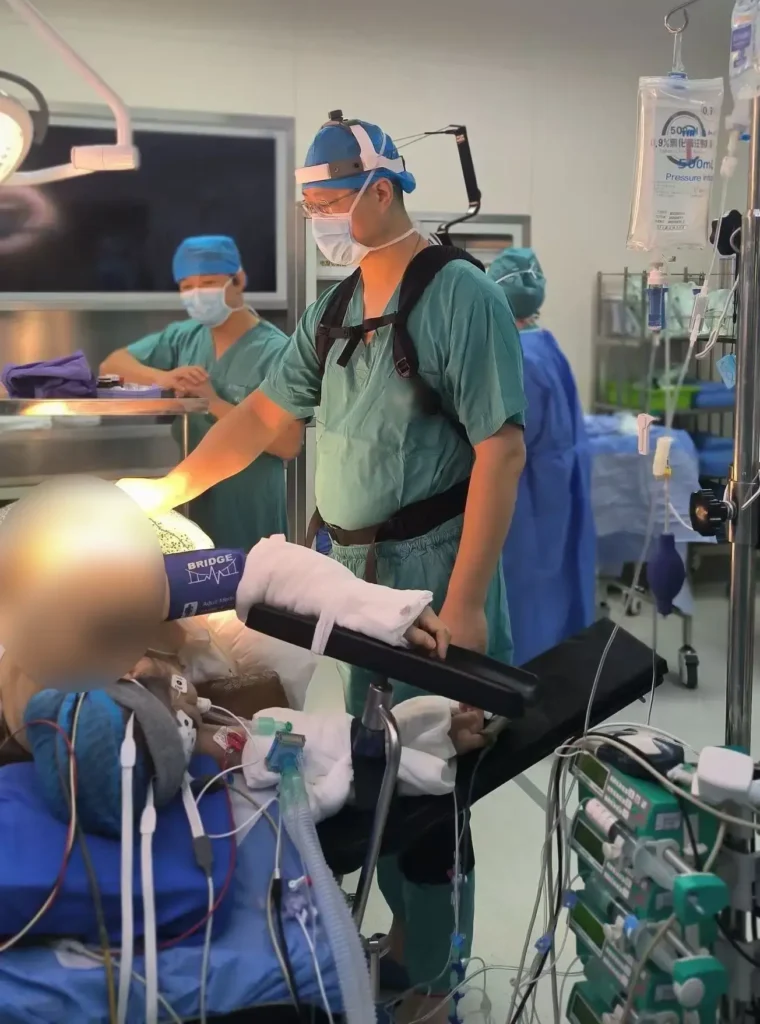
How a surgeon’s request helped shape our approach to wearable support.
It Started with a Surgeon’s Request
A senior neurosurgeon at a hospital in Beijing came to us with a practical challenge.
He often spent eight to ten hours a day performing surgery. On particularly busy days, there was little time to eat or rest. He described persistent neck problems and muscle fatigue after years of demanding work.
He wanted something practical: support for his head and neck that was lightweight, easy to put on, and allowed him to move as his work required.
That request became the starting point for our Spine Support Exoskeleton.
Designed Around the Working Day
Supporting the head was only part of the challenge. We also needed to consider how the device would fit into the wearer’s daily routine.
Our priorities were straightforward: keep weight low, make adjustments easy, and accommodate head movement and precise hand and arm work.
We also considered how the device would be worn with surgical clothing. The main body was designed to fit beneath a disposable surgical gown, while the head support could be worn over a disposable surgical cap.
These practical details helped shape the product from the beginning.
Finding the Right Balance in the Backplate
One of our key development challenges was the backplate.
It needed to help distribute the load from the head support while retaining enough flexibility to follow the curve of the wearer’s back. We wanted it to provide support without feeling unnecessarily rigid.
We chose carbon fiber to work toward that balance of low weight, structural support, and flexibility. Just as important as the material were the backplate’s shape and construction, which helped it fit the contours of the body.
Making Room for Different Users
The head support also needed to accommodate different wearers.
We designed an adjustable head structure that could be positioned to accommodate longer hair. The disposable foam pad at the head contact area can be replaced between procedures.
Together with adjustments to fit and support position, these details reflect a simple priority: the product should adapt to the person wearing it.
Learning from Early Use
A senior clinician at a dental hospital in Beijing shared her feedback after using the device for a day. Her work could involve around ten hours of dental surgery, and she had described substantial neck fatigue during her usual routine.
After that day of use, she reported noticeably less neck muscle fatigue.
This was one clinician’s personal experience, rather than a controlled clinical finding. It gave us useful feedback on comfort and support in a demanding work setting. Individual experiences may vary.
The Purpose Behind the Product
The Spine Support Exoskeleton grew out of a specific request from someone facing the physical demands of prolonged head-down work.
That request shaped our focus on lightweight construction, adjustable support, and practical wearability. Our goal is to offer support that fits into the working day and helps people feel more comfortable while doing work that requires their full attention.